
August 06, 2026
Western Red Cedar has been the benchmark natural timber cladding for decades, and it's worth understanding why it's held that position rather than just accepting it on reputation. It's not the cheapest option, and it's not the most durable in absolute terms — but it hits a combination of appearance, workability and genuine longevity that's hard to match.
Where it comes from and why that matters
Western Red Cedar is a North American softwood, native to the Pacific Northwest of the US and Canada. What sets it apart from most cladding-grade softwoods is that it's naturally durable without any chemical treatment — its natural oils give it real resistance to rot, decay and insect attack, in the same category as species like Larch rather than needing pressure treatment to perform outdoors.
It's also genuinely lightweight for a durable timber, which makes it easier to handle and fix than denser hardwood alternatives, without sacrificing much on durability for most UK exterior applications.
The weathering question
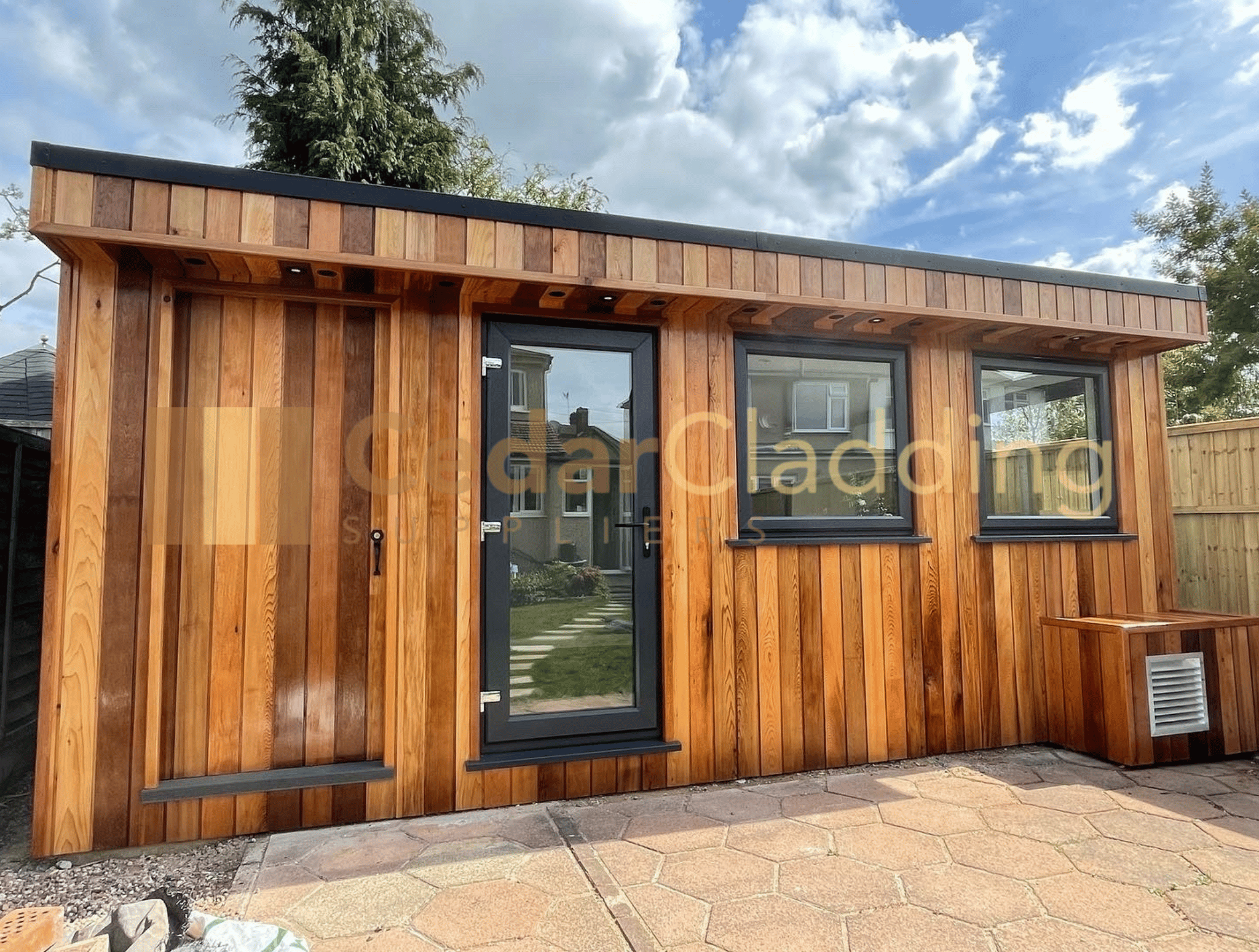
This is the thing most people ask about, and it's worth answering properly rather than glossing over. Left unfinished, Cedar weathers from its fresh warm, reddish-brown colour to a distinctive silver-grey over roughly the first year or two of exposure, depending on aspect and rainfall. This is a genuine, celebrated characteristic of the timber, not a defect — a huge amount of Cedar cladding is deliberately left unfinished specifically for this weathered look.
If you want to keep the original warm tone rather than let it silver, you'll need a UV-stable oil or stain, reapplied periodically. Both approaches are completely valid; it's purely down to which look you're after, and neither compromises the timber's underlying durability.
Grades and what they actually mean
Cedar is graded, and the grade genuinely affects both appearance and, to a lesser extent, price — it's not just a marketing distinction. Higher grades have fewer knots and a more uniform appearance, which matters more on a highly visible facade than on, say, a garden fence. It's worth asking your supplier specifically what grade you're being quoted for, rather than assuming "Cedar" alone tells you what you're getting — two suppliers quoting very different prices for nominally the same species are often quoting different grades.
Profiles and fitting
Cedar is available in a wide range of cladding profiles — channel groove, shiplap, bevel and others — giving more flexibility in the finished look than most other cladding species. Cedar shingles are also a distinct product in their own right, commonly used for roofing as well as decorative wall cladding, and worth considering separately if you're after a more textured, traditional look rather than flat boards.
Fixing and detailing
The same fundamentals apply as with any timber cladding: a ventilated cavity behind the boards, and stainless steel fixings rather than galvanised. Cedar's natural oils can actually accelerate corrosion in standard fixings faster than some other species, which makes this one area where cutting corners shows up sooner rather than later.
Cost
Cedar typically sits above Larch but can vary considerably depending on grade — a lower grade Cedar can be genuinely competitive with mid-range softwood options, while premium clear grades sit firmly in hardwood territory on price. This range is worth understanding before you start comparing quotes, since "Cedar" alone isn't a single price point.
Is Cedar right for your project?
Cedar makes sense where you want that specific, well-established weathered silver-grey look (or the warm original tone, maintained), workability that's easier than a dense hardwood, and genuine natural durability without a factory coating. If you want a uniform, non-weathering appearance without ongoing maintenance, a factory-finished option is a better fit — but for a natural, timeless timber facade, Cedar remains the reference point for good reason.
If you're specifying for a project and want help choosing grade, profile or coverage, our team can talk you through the options before you order.

General